
Pathological anatomy: microtomes and cryostats

Pathological anatomy is a science that studies the pathophysiological and morphological alterations of a disease. That is, it studies the disease at an organic, tissue, cellular and molecular level. For which it uses highly specialized equipment, among them we have the microtome and the cryostat.
What is a tissue processor in pathology?

Pathological anatomy is the science that is responsible for the study of pathophysiological and morphological alterations of the disease. Like all science, it has a series of specialized equipment to carry out the different studies on which it is based.
What are the equipment used in a pathology labtech?

In a technical laboratory of pathological anatomy different services are performed that perform activities, this service has two major divisions: the area of histopathology that carries out studies of tissue samples of patients, in addition to processing and analysis of biopsies for the diagnosis of diseases or contribute to explain the symptoms of the disease; and the cytopathology area, which is in charge of the study of cytological samples, the best known is the cervical-vaginal cytology; it also includes the analysis of aspiration biopsies and any body fluid such as: pleural, peritoneal, urine, CSF, expectoration, among other samples.
What are the different types of laboratory analyzers that exist?

We can find different types according to their applications or operation, and they may even have different names to refer to the same equipment, we can name them as laboratory analyzers, clinical analyzers or simply reagent analyzers.
What are the types of reagent analyzers that exist?

In a laboratory it is really important to understand the usefulness of each equipment, in the case of reagent analyzers, the analyzers are classified according to the tests that are required, the results that are desired to obtain, the automatic analyzers of laboratories, allow to facilitate the functions that are performed in it, the manufacturer of the analyzers is also part of the advantages and guarantees of each device, that is why in KALSTEIN, being manufacturers we guarantee them equipment of excellent quality.
Hematology analyzers and biochemistry analyzers: what are the differences?
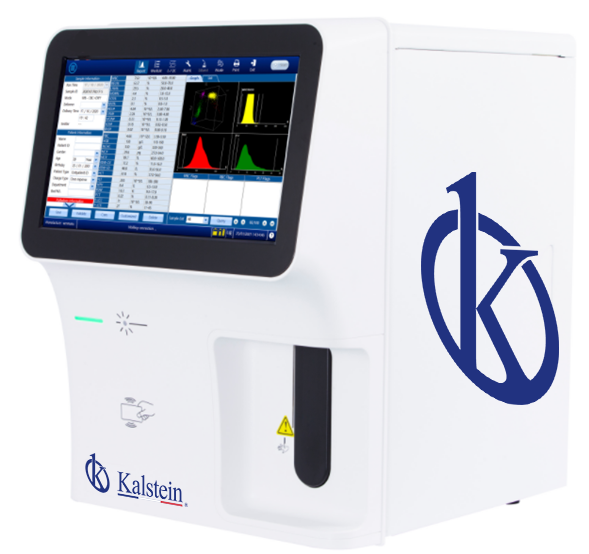
The differences between these teams are mainly focused on their applications, being hematology analyzers devices used for tests involving complete blood counts or blood counts, providing a quantitative and qualitative analysis of blood elements; for biochemical analyzers are used to determine metabolites that are present in biological samples, they can be blood or urine.
What are the different types of clinical chemistry analyzers that exist?

This type of analyser is also known as biochemistry analyzers, they are required equipment to determine the existing metabolites in biological samples such as blood and urine, the study of these fluids allows diagnosing diseases, which is why they are widely used in the areas of immunology, endocrinology, toxicology or oncology.
How does a Clinical Chemistry Analyser work?

The chemistry analyser is a clinical laboratory tool, designed to do blood tests, from 125 to 1600 photometric tests per hour. This equipment works mainly in clinical or hospital laboratories, its main function is to analyze the elements of a blood sample, to calculate the levels of triglycerides, cholesterol, proteins, among others.
What are the different types of hematology analyzers?

These kits are used for complete blood counts or blood counts, perform a quantitative and qualitative analysis of blood factors such as: red blood cells, erythrocytes, white blood cells, leukocytes, platelets and thrombocytes, are mainly used in laboratories of analysis of medical biology or in hospitals with hematology service.
Urine analyzers: what are they used for?

Urine analyzers are laboratory equipment that perform the automated analysis of several essential parameters of urine, allowing the detection of the presence of urinary tract infections, determination of pH, blood and protein loss, as well as evaluating the presence of analytes. such as glucose, ketone bodies, nitrites and bilirubin in urine.